Breast Lift Surgery (Mastopexy)
What is breast lift surgery (mastopexy)?
Breast lift, medically known as mastopexy, is a cosmetic surgical procedure performed to lift and reshape sagging or deflated breasts. In a pure breast lift, we do not significantly reduce breast tissue; instead, we reposition and tighten the existing breast tissue and skin to achieve a firmer, more youthful contour.
Who is a good candidate for a breast lift?
• Sagging or drooping breasts (ptosis)
• Deflated breasts after pregnancy or breastfeeding
• Massive or rapid weight loss
• Downward-pointing nipples
• Loss of upper pole fullness
• Good general health with realistic expectations
Why do breasts sag?
Breast sagging commonly occurs due to:
• Pregnancy and breastfeeding
• Ageing and gravity
• Massive weight loss
• Genetic skin laxity
• Hormonal changes
These factors cause skin stretching and loss of structural support.
Does breast lift reduce breast size?
No, a standard mastopexy is a lifting and reshaping procedure, not a reduction surgery. The breast volume is preserved, but the shape becomes firmer and more elevated. However, minor tissue reshaping may be done for symmetry and contour.
Where are the scars placed in breast lift surgery?
Scars depend on the degree of sagging and technique used:
• Around the areola (periareolar scar) – mild ptosis
• Vertical scar (lollipop scar) – moderate ptosis
• Anchor scar (around areola + vertical + fold) – severe ptosis
Commonly, there will be a scar below the nipple extending downward, which fades significantly over time with proper care.
Will the nipple be lifted during mastopexy?
Yes. The nipple-areola complex is repositioned to a more youthful and anatomically correct level without detaching it from its blood supply in most standard techniques.
Can breast lift be combined with implants?
Yes. If breasts are both sagging and deflated, a breast lift with augmentation can be performed to restore volume as well as lift the breast. This is commonly done in post-pregnancy or massive weight loss patients.
How long does breast lift surgery take?
• Surgery duration: 2–4 hours
• Anesthesia: General anesthesia
• Hospital stay: Usually 1 day
What is the recovery time after mastopexy?
• Back to light activities: 5–7 days
• Back to work: 7–10 days
• Exercise and heavy lifting: 4–6 weeks
• Final shape settling: 2–3 months
Swelling and mild tightness are normal in the early recovery phase.
Will the results look natural?
Yes. The goal of mastopexy is to create a natural, proportionate, and youthful breast contour rather than an over-tight or artificial appearance.
How long do the results of a breast lift last?
Results are long-lasting but not permanent because ageing, gravity, pregnancy, and weight fluctuations can affect breast shape over time. Maintaining a stable weight and supportive garments helps prolong results.
Will breastfeeding be possible after breast lift?
In many cases, breastfeeding ability is preserved, especially when glandular tissue and ducts are maintained. However, this may vary depending on the surgical technique and individual anatomy.
Is mastopexy painful?
Post-operative discomfort is usually mild to moderate and well-controlled with medications. Most patients tolerate the recovery comfortably.
My surgical philosophy for breast lift?
My approach focuses on tissue preservation, natural elevation, and proportionate reshaping rather than unnecessary tissue removal. The aim is to restore youthful breast position, improve contour after deflation or weight loss, and achieve aesthetically balanced, safe, and long-lasting results with meticulous scar placement and ethical patient selection.
Breast Reduction Surgery
What is breast reduction surgery?
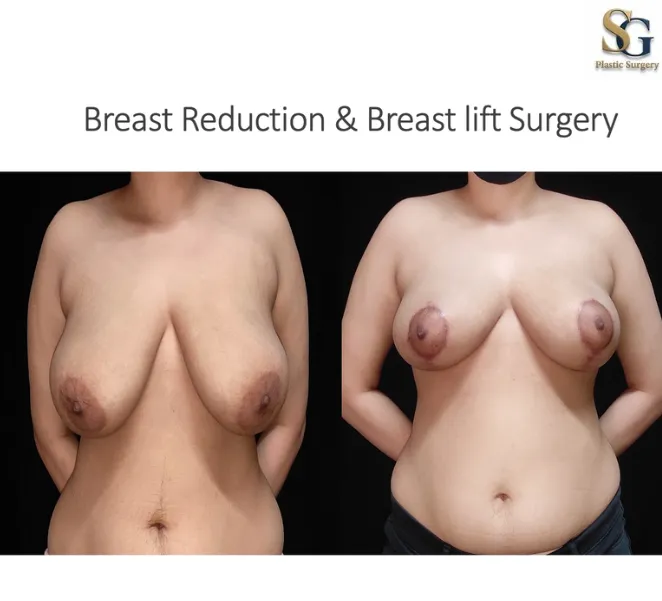
Breast reduction surgery (reduction mammoplasty) is a procedure to reduce the size, weight, and volume of excessively large breasts while reshaping them into a more proportionate and natural-looking contour.
Who are the ideal candidates for breast reduction?
• Women with heavy, large, or sagging breasts
• Chronic neck, shoulder, or back pain
• Shoulder strap grooves and skin irritation
• Difficulty in sports, running, or physical activity
• Athletes with functional limitations
• Postural problems due to heavy breasts
• Social discomfort or difficulty in daily activities
Can gigantomastia be treated with breast reduction?
Yes, gigantomastia can be effectively treated with breast reduction surgery. In fact, reduction mammaplasty is one of the most reliable and definitive treatments for excessively large, heavy, and symptomatic breasts. Using advanced techniques such as the MOCK superomedial pedicle technique (as devised by my guide Dr. Kapil Agrawal), even very large breasts can be reduced safely while maintaining good breast shape, projection, and vascularity of the nipple-areola complex. The goal is not just to reduce size, but to create a harmonious, natural-looking breast that is lighter, aesthetically pleasing, and proportionate to the patient’s body.
Will my breasts look natural after reduction?
Yes. The goal is not just reduction in size but creating a smaller, lifted, symmetrical, and natural-looking breast that matches the body proportions rather than a flat or over-reduced appearance.
Do you combine liposuction with breast reduction?
Yes, in selected patients, liposuction of the lateral breast and axillary (side chest) region is added to improve contour, reduce side bulge, and enhance overall aesthetic harmony.
How long does the surgery take?
• Surgery duration: Approximately 3–4 hours
• Anesthesia: General anesthesia
• Hospital stay: Usually 1–2 days
Will there be scars after breast reduction?
Yes, scars are a part of breast reduction surgery. Depending on the technique and breast size, scars may be:
• Around the areola
• Vertical (lollipop scar)
• Anchor-shaped (in large reductions)
These scars fade significantly over time and are strategically placed for better healing and concealment.
Will breast reduction also lift my breasts?
Yes. Breast reduction inherently includes a lifting (mastopexy effect), as the nipple-areola complex is repositioned to a more youthful and elevated position.
Can I breastfeed after breast reduction surgery?
Theoretically, yes, breastfeeding may still be possible after breast reduction surgery, especially when glandular tissue, ducts, and the nipple-areola blood supply are carefully preserved during dissection. In modern techniques, we make every effort to preserve the lactational glands and functional breast tissue.
However, it is important to understand that the exact amount of breast tissue removed varies from patient to patient, and healing is ultimately biological and unpredictable. Some women may breastfeed successfully, while others may have reduced milk production.
For this reason, we usually prefer to perform breast reduction after the family is complete or after two children, whenever feasible. In unmarried women or women planning future pregnancies, detailed counseling and informed consent are essential, as breastfeeding capability cannot be guaranteed despite meticulous surgical planning.
What is the recovery time?
• Back to light work: 7–10 days
• Routine activities: 2 weeks
• Exercise and heavy activity: 4–6 weeks
• Final shape settling: 3–4 months
Is breast reduction painful?
Post-operative discomfort is moderate and manageable with medications. Most patients experience significant relief from chronic pain soon after recovery.
What are the long-term benefits of breast reduction?
• Relief from neck, shoulder, and back pain
• Improved posture
• Better mobility and exercise tolerance
• Enhanced body proportions
• Improved self-confidence and clothing comfort
• Better quality of life
Is preoperative planning important in breast reduction?
Absolutely. Detailed markings, measurements, symmetry analysis, and surgical planning are crucial for safe surgery, proper nipple positioning, and aesthetically pleasing long-term results.
What do patients usually feel after breast reduction?
Most patients report dramatic physical relief and improved confidence. A very common response after recovery is that undergoing breast reduction was one of the most life-changing and satisfying decisions for their health and lifestyle.
What is breast lift surgery (mastopexy)?
Breast lift, medically known as mastopexy, is a cosmetic surgical procedure performed to lift and reshape sagging or deflated breasts. In a pure breast lift, we do not significantly reduce breast tissue; instead, we reposition and tighten the existing breast tissue and skin to achieve a firmer, more youthful contour.
Who is a good candidate for a breast lift?
• Sagging or drooping breasts (ptosis)
• Deflated breasts after pregnancy or breastfeeding
• Massive or rapid weight loss
• Downward-pointing nipples
• Loss of upper pole fullness
• Good general health with realistic expectations
Why do breasts sag?
Breast sagging commonly occurs due to:
• Pregnancy and breastfeeding
• Ageing and gravity
• Massive weight loss
• Genetic skin laxity
• Hormonal changes
These factors cause skin stretching and loss of structural support.
Does breast lift reduce breast size?
No, a standard mastopexy is a lifting and reshaping procedure, not a reduction surgery. The breast volume is preserved, but the shape becomes firmer and more elevated. However, minor tissue reshaping may be done for symmetry and contour.
Where are the scars placed in breast lift surgery?
Scars depend on the degree of sagging and technique used:
• Around the areola (periareolar scar) – mild ptosis
• Vertical scar (lollipop scar) – moderate ptosis
• Anchor scar (around areola + vertical + fold) – severe ptosis
Commonly, there will be a scar below the nipple extending downward, which fades significantly over time with proper care.
Will the nipple be lifted during mastopexy?
Yes. The nipple-areola complex is repositioned to a more youthful and anatomically correct level without detaching it from its blood supply in most standard techniques.
Can breast lift be combined with implants?
Yes. If breasts are both sagging and deflated, a breast lift with augmentation can be performed to restore volume as well as lift the breast. This is commonly done in post-pregnancy or massive weight loss patients.
How long does breast lift surgery take?
• Surgery duration: 2–4 hours
• Anesthesia: General anesthesia
• Hospital stay: Usually 1 day
What is the recovery time after mastopexy?
• Back to light activities: 5–7 days
• Back to work: 7–10 days
• Exercise and heavy lifting: 4–6 weeks
• Final shape settling: 2–3 months
Swelling and mild tightness are normal in the early recovery phase.
Will the results look natural?
Yes. The goal of mastopexy is to create a natural, proportionate, and youthful breast contour rather than an over-tight or artificial appearance.
How long do the results of a breast lift last?
Results are long-lasting but not permanent because ageing, gravity, pregnancy, and weight fluctuations can affect breast shape over time. Maintaining a stable weight and supportive garments helps prolong results.
Will breastfeeding be possible after breast lift?
In many cases, breastfeeding ability is preserved, especially when glandular tissue and ducts are maintained. However, this may vary depending on the surgical technique and individual anatomy.
Is mastopexy painful?
Post-operative discomfort is usually mild to moderate and well-controlled with medications. Most patients tolerate the recovery comfortably.
My surgical philosophy for breast lift?
My approach focuses on tissue preservation, natural elevation, and proportionate reshaping rather than unnecessary tissue removal. The aim is to restore youthful breast position, improve contour after deflation or weight loss, and achieve aesthetically balanced, safe, and long-lasting results with meticulous scar placement and ethical patient selection.
Breast Reduction Surgery
What is breast reduction surgery?
Breast reduction surgery (reduction mammoplasty) is a procedure to reduce the size, weight, and volume of excessively large breasts while reshaping them into a more proportionate and natural-looking contour.
Who are the ideal candidates for breast reduction?
• Women with heavy, large, or sagging breasts
• Chronic neck, shoulder, or back pain
• Shoulder strap grooves and skin irritation
• Difficulty in sports, running, or physical activity
• Athletes with functional limitations
• Postural problems due to heavy breasts
• Social discomfort or difficulty in daily activities
Can gigantomastia be treated with breast reduction?
Yes, gigantomastia can be effectively treated with breast reduction surgery. In fact, reduction mammaplasty is one of the most reliable and definitive treatments for excessively large, heavy, and symptomatic breasts. Using advanced techniques such as the MOCK superomedial pedicle technique (as devised by my guide Dr. Kapil Agrawal), even very large breasts can be reduced safely while maintaining good breast shape, projection, and vascularity of the nipple-areola complex. The goal is not just to reduce size, but to create a harmonious, natural-looking breast that is lighter, aesthetically pleasing, and proportionate to the patient’s body.
Will my breasts look natural after reduction?
Yes. The goal is not just reduction in size but creating a smaller, lifted, symmetrical, and natural-looking breast that matches the body proportions rather than a flat or over-reduced appearance.
Do you combine liposuction with breast reduction?
Yes, in selected patients, liposuction of the lateral breast and axillary (side chest) region is added to improve contour, reduce side bulge, and enhance overall aesthetic harmony.
How long does the surgery take?
• Surgery duration: Approximately 3–4 hours
• Anesthesia: General anesthesia
• Hospital stay: Usually 1–2 days
Will there be scars after breast reduction?
Yes, scars are a part of breast reduction surgery. Depending on the technique and breast size, scars may be:
• Around the areola
• Vertical (lollipop scar)
• Anchor-shaped (in large reductions)
These scars fade significantly over time and are strategically placed for better healing and concealment.
Will breast reduction also lift my breasts?
Yes. Breast reduction inherently includes a lifting (mastopexy effect), as the nipple-areola complex is repositioned to a more youthful and elevated position.
Can I breastfeed after breast reduction surgery?
Theoretically, yes, breastfeeding may still be possible after breast reduction surgery, especially when glandular tissue, ducts, and the nipple-areola blood supply are carefully preserved during dissection. In modern techniques, we make every effort to preserve the lactational glands and functional breast tissue.
However, it is important to understand that the exact amount of breast tissue removed varies from patient to patient, and healing is ultimately biological and unpredictable. Some women may breastfeed successfully, while others may have reduced milk production.
For this reason, we usually prefer to perform breast reduction after the family is complete or after two children, whenever feasible. In unmarried women or women planning future pregnancies, detailed counseling and informed consent are essential, as breastfeeding capability cannot be guaranteed despite meticulous surgical planning.
What is the recovery time?
• Back to light work: 7–10 days
• Routine activities: 2 weeks
• Exercise and heavy activity: 4–6 weeks
• Final shape settling: 3–4 months
Is breast reduction painful?
Post-operative discomfort is moderate and manageable with medications. Most patients experience significant relief from chronic pain soon after recovery.
What are the long-term benefits of breast reduction?
• Relief from neck, shoulder, and back pain
• Improved posture
• Better mobility and exercise tolerance
• Enhanced body proportions
• Improved self-confidence and clothing comfort
• Better quality of life
Is preoperative planning important in breast reduction?
Absolutely. Detailed markings, measurements, symmetry analysis, and surgical planning are crucial for safe surgery, proper nipple positioning, and aesthetically pleasing long-term results.
What do patients usually feel after breast reduction?
Most patients report dramatic physical relief and improved confidence. A very common response after recovery is that undergoing breast reduction was one of the most life-changing and satisfying decisions for their health and lifestyle.
Keywords